
Veolia Electrodeionization EDI Stack Modules
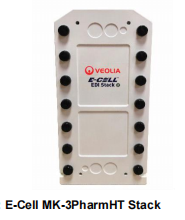
Veolia E-Cell EDI MK-3PharmHT Stack for Hot-Water Sanitization up to 85°C
1.Product OverviewThe Veolia E-Cell EDI MK-3PharmHT Stack is an electrodeionization stack that uses electrical current to polish RO permeate or equivalent pretreated water. Designed for pharmaceutical and biotechnology water systems, it can be hot-water sanitized at up to 85°C (185°F)
1. Product Overview
The Veolia E-Cell EDI MK-3PharmHT Stack is an electrodeionization stack that uses electrical current to polish RO permeate or equivalent pretreated water. Designed for pharmaceutical and biotechnology water systems, it can be hot-water sanitized at up to 85°C (185°F) for 160 cycles.
2. PRODUCT SPECIFICATIONS
Item | Specification |
Brand | Veolia |
Model | E-Cell EDI MK-3PharmHT Stack |
Product type | Electrodeionization (EDI) stack |
Internal treatment medium | Packed-bed ion exchange medium |
Nominal flow | 3.4 m³/h (15 gpm) |
Flow rate range | 1.6–5.4 m³/h (7.0–23.8 gpm) |
Dimensions (W × H × D) | 30 × 61 × 54 cm |
Shipping weight | 100 kg (220 lb) |
3. OPERATING PARAMETERS
Parameter | Value / Range |
Recovery | Up to 96%; subject to design conditions |
Operating feed-water temperature | 4.4–40°C (40–104°F) |
Operating inlet pressure | ≤6.9 bar (100 psi); required pressure depends on downstream pressure requirements, flow configuration and stack pressure drop |
Pressure drop | 1.4–2.8 bar (20–40 psi) at nominal flow and 25°C |
Voltage | 0–300 VDC |
Amperage | 0–5.2 ADC |
Feed-water pH | 4–11 |
Feed-water source and particulate requirement | RO permeate or equivalent feed-water quality. If an open system is located between pretreatment and the stack, install a filter immediately before the stack |
Total exchangeable anions (TEA, as CaCO₃) | ≤63.6 ppm; table value is at minimum flow and maximum operating temperature. Confirm acceptability under the specific operating conditions |
Conductivity equivalent | ≤109 μS/cm |
Total hardness (as CaCO₃) | ≤1.0 ppm for standard counter-current operation; ≤0.1 ppm for co-current operation |
Feed-water silica (as SiO₂) | ≤1.0 ppm; the allowable limit decreases above nominal flow and is ≤0.5 ppm when feed-water hardness exceeds 0.5 ppm as CaCO₃ |
Total organic carbon (TOC, as C) | ≤0.5 ppm |
Total chlorine | ≤0.05 ppm |
Fe, Mn and H₂S | ≤0.01 ppm |
Boron | ≤1.0 ppm; ≤0.3 ppm as B when a silica guarantee or a resistivity guarantee above 10 MOhm-cm is required |
Oil and grease | None detectable |
Oxidizing agents | None detectable |
Color | ≤5 APHA |
Maximum hot-water sanitization temperature | 85°C (185°F); sanitization condition, not normal operating temperature |
Maximum hot-water sanitization inlet pressure | 2.1 bar (30 psi) |
Hot-water sanitization cycles | 160 cycles |
Feed-water limits and expected product-water quality should be verified for the specific design conditions using Veolia’s Winflows projection software and the E-Cell Stack Owner’s Manual.
4. Key Features & Benefits
Hot-water sanitization: The stack can be sanitized at up to 85°C (185°F) for 160 cycles, supporting systems that require a hot-water-sanitizable EDI stack.
Defined flow range: A nominal flow of 3.4 m³/h (15 gpm) and a flow range of 1.6–5.4 m³/h (7.0–23.8 gpm) provide sizing references for system design.
Counter-current operation: This configuration supports a feed-water hardness limit of ≤1.0 ppm as CaCO₃, compared with ≤0.1 ppm for co-current operation.
Product-water quality projections: A resistivity guarantee of ≥10 MOhm-cm may be available. Expected quality and guarantee availability must be verified for the design conditions in Winflows.
5. Key Applications
Water-for-injection systems
Pharmaceutical purified-water systems
Laboratory purified-water systems
Send Your Water Treatment Requirement
Tell us the feedwater, required capacity, target water quality and project conditions. Your inquiry email will automatically include the page you are viewing so our team can understand the exact product, technology or reference that led to your request.
- Feedwater source / available analysis
- Design flow or required production capacity
- Target product-water quality or process duty
- Project country, operating conditions and delivery target