
Veolia Electrodeionization EDI Stack Modules
Veolia E-Cell MK-9D EDI Stack – New Model, 16 m³/h Nominal Flow for Industrial Ultrapure Water
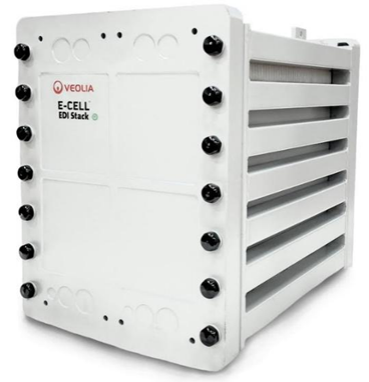
1. Product OverviewThe Veolia E-Cell MK-9D is a continuous electrodeionization (EDI) stack designed to produce ultrapure water for industrial applications. It uses electrical current to regenerate the ion exchange media continuously, eliminating the need for acid or caustic regeneration of the resin
1. Product Overview
The Veolia E-Cell MK-9D is a continuous electrodeionization (EDI) stack designed to produce ultrapure water for industrial applications. It uses electrical current to regenerate the ion exchange media continuously, eliminating the need for acid or caustic regeneration of the resin within the stack.
With a nominal flow of 16.0 m³/h and a flow range of 8.4–20.0 m³/h, the MK-9D supports demanding applications in power generation, solar panel production, microelectronics, and green hydrogen generation.
The stack operates without brine injection or concentrate recirculation. Its counter-current design helps minimize cleaning requirements at higher allowable feed water hardness levels.
2. PRODUCT SPECIFICATIONS
General Specifications
| Parameter | Specification |
|---|---|
| Brand | Veolia |
| Product Series | E-Cell |
| Model | MK-9D |
| Product Type | Continuous Electrodeionization (EDI) Stack |
| Nominal Flow | 16.0 m³/h (70.4 gpm) |
| Flow Rate Range | 8.4–20.0 m³/h (37.0–88.1 gpm) |
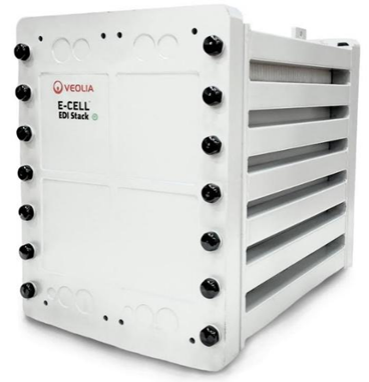
| Dimensions — Width × Height × Depth | 48 × 61 × 76 cm (19 × 24 × 30 in.) |
| Shipping Weight | 290 kg (639 lb) |
Product Water Quality and Removal Performance
| Parameter | Datasheet Performance |
|---|---|
| Product Water Resistivity | ≥ 16 MΩ·cm — guarantee available for verified design conditions |
| Product Water Sodium | ≤ 3 ppb — guarantee available for verified design conditions |
| Product Water Silica (SiO₂) | As low as 5 ppb — subject to verified design conditions |
| Typical Sodium Removal | ≥ 99.9% |
| Typical Silica Removal | Up to 99% |
Performance note: Actual product water quality depends on site conditions, feed water quality, and operating parameters. Expected performance and applicable resistivity, sodium, and silica guarantees must be verified using the Winflows Design Simulator or confirmed by Veolia. Boron and other specific guarantees require separate confirmation.
Quality Assurance
cCSAus marked and CE compliant.
Manufactured in an ISO 9001 and ISO 14001 certified facility.
Halal certified by the Islamic Food and Nutrition Council of America (IFANCA®).
3. OPERATING PARAMETERS
Stack Operating Conditions
| Parameter | Specification |
|---|---|
| Recovery | Up to 97% |
| DC Voltage | 0–400 VDC |
| DC Current | 0–11 ADC |
| Inlet Pressure | ≤ 6.9 bar (100 psi) |
| Pressure Drop | 2.4–3.4 bar (35–50 psi), at nominal flow and 25°C |
Inlet pressure depends on downstream product and concentrate pressure requirements, the flow configuration, and stack pressure drop. Operating conditions must be verified for the specific system design.
Feed Water Requirements
| Parameter | Feed Water Specification |
|---|---|
| Total Exchangeable Anions — TEA, as CaCO₃ | ≤ 36 ppm¹ |
| Conductivity Equivalent | ≤ 62 µS/cm |
| Temperature | 4.4–40°C (40–104°F) |
| Total Hardness, as CaCO₃ | ≤ 1.0 ppm in counter-current operation² |
| Silica, as SiO₂ | ≤ 1.0 ppm, subject to flow and hardness limits³ |
| Total Organic Carbon — TOC, as C | ≤ 0.5 ppm |
| Total Chlorine | ≤ 0.05 ppm |
| Fe, Mn, H₂S | ≤ 0.01 ppm |
| Boron | ≤ 1.0 ppm, subject to performance requirements⁴ |
| pH | 4–11 |
| Oil and Grease | None detectable |
| Particulate | RO permeate or equivalent feed water quality |
| Oxidizing Agents | None detectable |
| Color | ≤ 5 APHA |
Feed water design notes
TEA: Includes contributions from all feed water anions, including OH⁻, CO₂, and SiO₂. The stated limit applies at minimum flow and maximum temperature. Suitability must be verified in Winflows.
Hardness: The 1.0 ppm limit applies only to standard counter-current operation. In co-current operation, the limit decreases to 0.1 ppm as CaCO₃.
Silica: The allowable limit decreases above 10 m³/h. It also decreases to 0.5 ppm when feed water hardness exceeds 0.5 ppm as CaCO₃. The allowable silica concentration must therefore be checked at the MK-9D nominal flow of 16.0 m³/h.
Boron: The feed limit decreases to 0.3 ppm as B when a silica guarantee or a resistivity guarantee above 10 MΩ·cm is required.
Upstream filtration: Where an open system, such as a tank or decarbonator, is installed between RO and EDI, a filter must be fitted immediately before the stack. A 5 µm absolute or 1 µm nominal filter is generally acceptable.
Final feed water suitability should be verified against the system design and the E-Cell EDI Stack Owner’s Manual.
4. Key Features & Benefits
Continuous ultrapure water production
Electrical regeneration supports continuous operation without periodic acid or caustic regeneration of the resin within the stack.Industrial flow capacity
A nominal flow of 16.0 m³/h and an operating flow range of 8.4–20.0 m³/h support industrial ultrapure water requirements.Simplified process configuration
No brine injection or concentrate recirculation is required.Counter-current operation
Helps minimize cleaning requirements at higher allowable feed water hardness levels.High recovery capability
Recovery of up to 97% is available, subject to verified design conditions.Sodium and silica removal
Provides removal of residual dissolved contaminants for demanding industrial water applications.Design and performance verification
Winflows performance projections support stack selection and confirmation of expected product water quality.
5. Key Applications
The Veolia E-Cell MK-9D EDI stack is designed for industrial ultrapure and demineralized water applications, including:
| Application | Typical Use |
|---|---|
| Power Generation | Demineralized feed water for high-pressure boilers |
| Solar Panel Production | Ultrapure water for rinsing applications |
| Microelectronics Manufacturing | Ultrapure water for rinsing microelectronic components |
| Green Hydrogen Generation | Ultrapure water supply for electrolyzers |
| Heavy Industry | Demineralized boiler feed water and other demanding ultrapure water applications |
Send Your Water Treatment Requirement
Tell us the feedwater, required capacity, target water quality and project conditions. Your inquiry email will automatically include the page you are viewing so our team can understand the exact product, technology or reference that led to your request.
- Feedwater source / available analysis
- Design flow or required production capacity
- Target product-water quality or process duty
- Project country, operating conditions and delivery target