
Solution
MBR Curtain Membrane Modules for Industrial Wastewater Reuse
Factories often produce wastewater with variable organic loads, suspended solids, oil, chemicals, and process-specific contaminants. These fluctuations can challenge biological treatment and downstream filtration, especially when a facility aims to reuse treated water or reduce freshwater consumptio
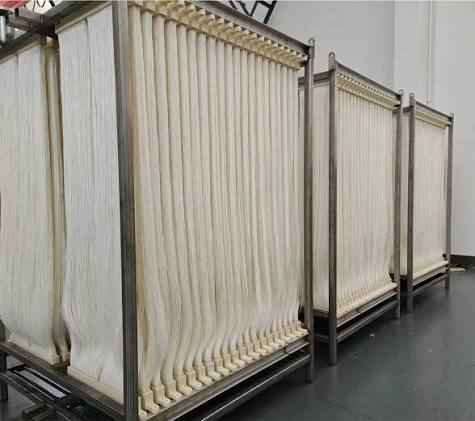
Factories often produce wastewater with variable organic loads, suspended solids, oil, chemicals, and process-specific contaminants. These fluctuations can challenge biological treatment and downstream filtration, especially when a facility aims to reuse treated water or reduce freshwater consumption.
An MBR system combines biological treatment with submerged membrane separation. MBR curtain modules can be used to separate permeate from activated sludge, while upstream and downstream processes are selected according to the wastewater composition and reuse target.
Industrial Wastewater Treatment Challenges
Industrial wastewater projects may need to manage:
Variations in flow and pollutant concentration
High organic loading or suspended solids
Oil, grease, or cleaning chemicals
Biological inhibition from specific process chemicals
Limited space for treatment upgrades
Water reuse targets and freshwater costs
Fouling risks in downstream RO or other polishing systems
Requirements for reliable operation during production changes
A practical design begins with wastewater characterization and the intended water reuse application. A generic membrane selection based only on nominal capacity may not account for toxicity, oil, salinity, temperature, or cleaning requirements.
Typical MBR Process Configuration
A typical industrial wastewater process may include:
Process Wastewater → Equalization → Oil and Solids Removal, If Required → Biological Treatment → MBR Curtain Membrane Tank → Disinfection or Polishing → Reuse or Discharge
Depending on the wastewater, the treatment train may also require:
pH adjustment
Coagulation and clarification
Oil-water separation
Anaerobic or aerobic biological treatment
Nutrient balancing
Activated carbon
Reverse osmosis or other desalination
Advanced oxidation
Sludge thickening and dewatering
MBR membrane filtration primarily separates suspended solids and biomass from the permeate. Dissolved salts and many dissolved chemicals may require additional treatment.
Potential Benefits for Industrial Facilities
Consistent Solid-Liquid Separation
Membrane filtration can provide a physical barrier between mixed liquor and permeate. Actual permeate quality depends on membrane integrity, operation, and the full process design.
Support for Reuse Projects
When combined with suitable disinfection or polishing, MBR permeate can serve as feedwater for selected industrial reuse applications.
Process Integration Flexibility
MBR systems can be considered for new plants, expansions, or retrofits. Reuse of existing tanks and equipment depends on dimensions, structural condition, aeration, hydraulics, and control requirements.
Reduced Dependence on Secondary Clarification
The membrane separation stage can replace or reduce the role of a conventional secondary clarifier in a properly designed MBR configuration.
Modular Capacity Planning
Membrane cassettes can be arranged to match project capacity and tank geometry. A staged design may be possible where expansion is expected.
Operating and Maintenance Considerations
Reliable MBR operation requires a coordinated process design, not just membrane selection. Key operating considerations include:
Influent screening and protection from fibrous debris
Control of oil, grease, and toxic compounds
Mixed liquor suspended solids and sludge age
Aeration and membrane air-scour requirements
Permeate flux and filtration cycle
Backwash and chemical cleaning strategy
Transmembrane pressure and permeability trends
Membrane integrity monitoring
Sludge wasting and disposal
Planned shutdown and preservation procedures
Cleaning chemicals, concentrations, exposure limits, and cleaning sequences must follow the specific membrane manufacturer’s instructions.
Information Needed for Technical Review
Please provide:
Wastewater source and process description
Flow rates, including peak and batch flows
Influent analysis: COD, BOD, TSS, oil and grease, pH, temperature, salinity, and relevant inhibitors
Required discharge or reuse quality
Existing process flow diagram
Tank dimensions and available installation space
Aeration system details
Current membrane make, model, and module dimensions, if replacing
Operating data, cleaning history, and known performance issues
Destination country and project schedule
Frequently Asked Questions
Can an MBR system treat all types of industrial wastewater?
No. Treatability depends on the wastewater composition and its effect on biological treatment and membranes. Toxic, high-salinity, oily, or solvent-containing streams may need pretreatment or a different process.
Does an MBR membrane remove dissolved salts?
No. MBR membranes separate suspended solids and biomass but do not perform desalination. RO or another suitable process may be needed if dissolved salts must be removed.
Can an MBR system be retrofitted into an existing plant?
Possibly. The tank structure, water depth, module dimensions, aeration capacity, hydraulic profile, sludge handling, and control system must be reviewed first.
How can we identify a replacement MBR curtain module?
Share the existing module’s nameplate, dimensions, connector details, membrane configuration, system drawings, and operating conditions. We will review compatibility before proposing a replacement.
Request a Quote
For an industrial MBR curtain membrane solution, send us your wastewater analysis, flow profile, reuse target, process diagram, tank dimensions, and project location. We can support preliminary module identification, replacement compatibility review, technical document coordination, export packaging, and international delivery.
Send Your Water Treatment Requirement
Tell us the feedwater, required capacity, target water quality and project conditions. Your inquiry email will automatically include the page you are viewing so our team can understand the exact product, technology or reference that led to your request.
- Feedwater source / available analysis
- Design flow or required production capacity
- Target product-water quality or process duty
- Project country, operating conditions and delivery target