
Solution
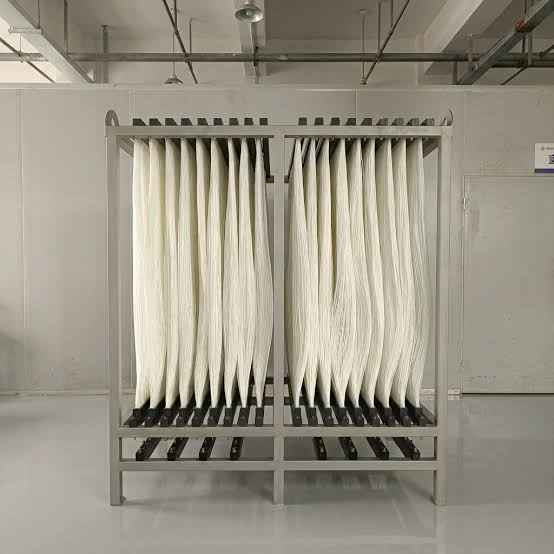
MBR Curtain Membrane Modules for Food and Beverage Wastewater
Food and beverage production can generate wastewater with high and variable organic loads. Cleaning-in-place (CIP) discharges, product losses, fats, oils, grease, suspended solids, and changes in pH may place additional demands on the treatment plant.A membrane bioreactor (MBR) combines biological t
Food and beverage production can generate wastewater with high and variable organic loads. Cleaning-in-place (CIP) discharges, product losses, fats, oils, grease, suspended solids, and changes in pH may place additional demands on the treatment plant.
A membrane bioreactor (MBR) combines biological treatment with membrane filtration. Submerged MBR curtain membrane modules separate treated water from activated sludge, supporting a compact treatment process for suitable food and beverage wastewater applications.
The right configuration depends on the factory’s production process, wastewater analysis, discharge permit, water reuse target, and operating schedule. MBR is not a universal treatment solution; pretreatment and process controls are important where wastewater contains significant grease, chemicals, or fluctuating loads.
Common Wastewater Challenges in Food and Beverage Plants
Food and beverage facilities may need to manage:
High BOD and COD from product residues
Variable flow during production and cleaning cycles
Fats, oils, and grease
Suspended solids from raw materials and processing
Sudden pH changes from CIP discharges
Salts, detergents, and sanitizing chemicals
Limited space for treatment plant expansion
Requirements for stable effluent quality or water reuse
The practical objective is:
To manage variable wastewater loads and produce treated water that meets the facility’s discharge or reuse requirements.
Typical MBR Treatment Process
A food and beverage wastewater system may use the following process:
Production Wastewater → Screening → Equalization → Grease or Solids Removal, If Required → pH Adjustment → Biological Treatment → MBR Curtain Membrane Tank → Disinfection or Polishing → Discharge or Reuse
Additional treatment may be required depending on the wastewater and reuse target. Possible process steps include dissolved air flotation (DAF), coagulation, anaerobic treatment, activated carbon, nutrient removal, or reverse osmosis.
The MBR membrane stage separates suspended solids and biomass from the permeate. It does not remove all dissolved salts or dissolved organic compounds, so additional polishing may be necessary for some reuse applications.
Potential Benefits
Handles Process Variations with Proper Equalization
An equalization tank can help reduce the impact of production and cleaning cycles on downstream biological treatment. Its sizing and control strategy should be based on the actual flow profile.
Provides Membrane-Based Solid Separation
Submerged MBR membranes separate permeate from activated sludge. Stable operation depends on membrane integrity, suitable loading, aeration, and cleaning management.
Supports Compact Plant Layouts
MBR may be considered where space is limited or where an existing treatment plant needs an upgrade. Site-specific evaluation is required to determine whether existing tanks can be reused.
Supports Water Reuse Schemes
MBR permeate may be considered as feed to further treatment for selected non-product-contact applications, subject to local regulations and the required water quality.
Allows Automated Process Monitoring
A complete system can monitor flow, pressure, aeration, tank levels, and other process parameters to support operational control and maintenance planning.
Design Considerations for Food and Beverage Wastewater
Before selecting MBR curtain membrane modules, assess:
Average and peak wastewater flows
Production and cleaning schedules
BOD, COD, TSS, fats, oils, and grease
pH and temperature variations
CIP chemicals and sanitizers
Salinity and nutrient balance
Existing pretreatment and biological process
Discharge or reuse requirements
Membrane tank dimensions and available depth
Aeration capacity and blower arrangement
Sludge handling and disposal requirements
Where wastewater includes high grease, strong cleaning chemicals, or toxic substances, upstream treatment and controlled discharge may be necessary to protect the biological process and membranes.
Frequently Asked Questions
Is an MBR suitable for food and beverage wastewater?
It may be suitable for wastewater that can be biologically treated and appropriately pretreated. A wastewater analysis and process review are needed before confirming the design.
Does an MBR remove fats, oils, and grease?
The membrane separates suspended material, but high concentrations of grease can cause operational problems. Grease removal or other pretreatment may be required.
Can MBR permeate be reused in production?
Reuse depends on the intended use, local regulations, and the required water quality. Product-contact applications require additional assessment and treatment; MBR permeate alone should not be assumed suitable.
What information is needed for an MBR membrane quotation?
Provide the influent analysis, flow profile, effluent target, existing process diagram, tank dimensions, membrane model if replacing, and project location.
Request a Quote
For an MBR curtain membrane solution for food and beverage wastewater, send us your wastewater analysis, production flow profile, discharge or reuse target, process diagram, and tank drawings. For replacement projects, include the existing module’s nameplate and dimensions.
We can assist with preliminary module identification, compatibility review, technical document coordination, export packing, and shipping arrangements.
Send Your Water Treatment Requirement
Tell us the feedwater, required capacity, target water quality and project conditions. Your inquiry email will automatically include the page you are viewing so our team can understand the exact product, technology or reference that led to your request.
- Feedwater source / available analysis
- Design flow or required production capacity
- Target product-water quality or process duty
- Project country, operating conditions and delivery target