
Solution
Condensate Polishing Resin Replacement: Specifying and Commissioning a Full Bed Change-Out
Plan a condensate polishing resin replacement around the outage window: cation, anion, inert and pre-mixed options, verified technical data, loading sequence and acceptance checks.
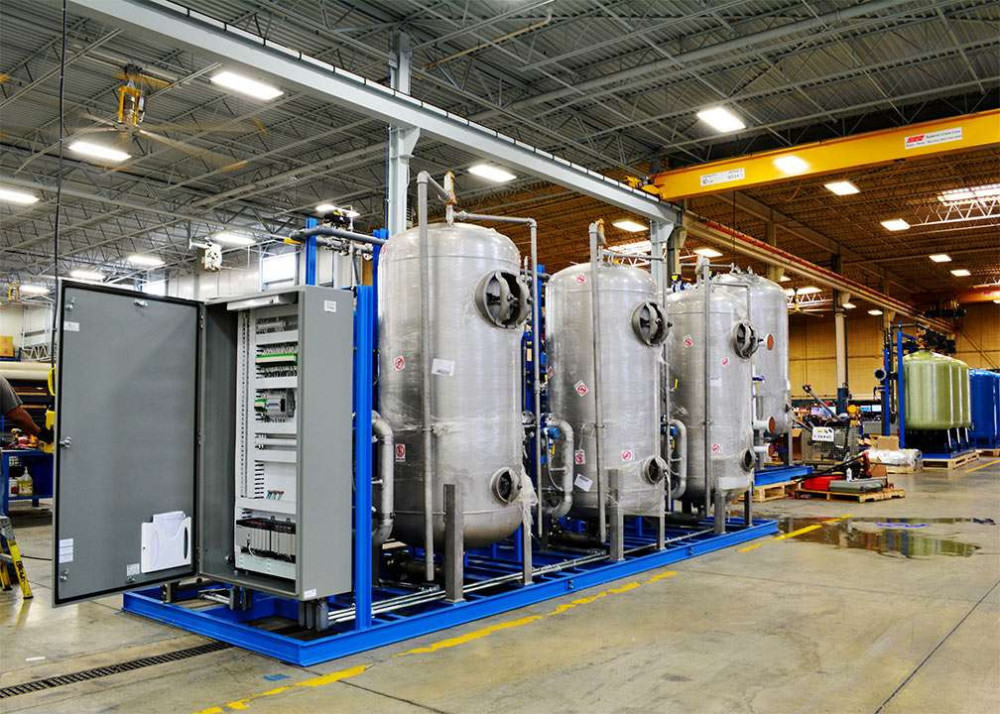
Condensate Polishing Resin Replacement: Specifying and Commissioning a Full Bed Change-Out
A condensate polishing resin replacement is not a like-for-like purchase. The bed that came out of the vessel has a history — attrition fines, osmotic cycling, fouling, and a separation interface that no longer behaves the way the design assumed. Specifying the replacement therefore means re-answering the original design questions with the plant's current operating reality: what temperature does the condensate actually reach, what oxidant residual is present, is the polisher operated as a mixed bed or as a layered bed, and how many hours are available between demobilisation and returns-to-service.
This guide covers the resin options used in condensate polishing duty, the data that distinguishes them, how to match a pair to a specific vessel configuration, and the execution sequence that lets a full change-out fit inside a single outage window. All technical values are taken from the current DuPont AmberLite and AmberTec product data sheets.
It addresses resin selection, ordering, handling and commissioning for a scheduled full-bed change-out. It does not cover vessel or underdrain redesign, control-system retrofit, or the condensate-polisher system design itself; those are scoped separately against the plant's vessel and chemistry data.
Why Condensate Polishing Beds Reach Their Limit
Condensate polishers run at high flow, high temperature and low ionic strength — the harshest combination an ion exchange resin is asked to tolerate. Three mechanisms usually act together.
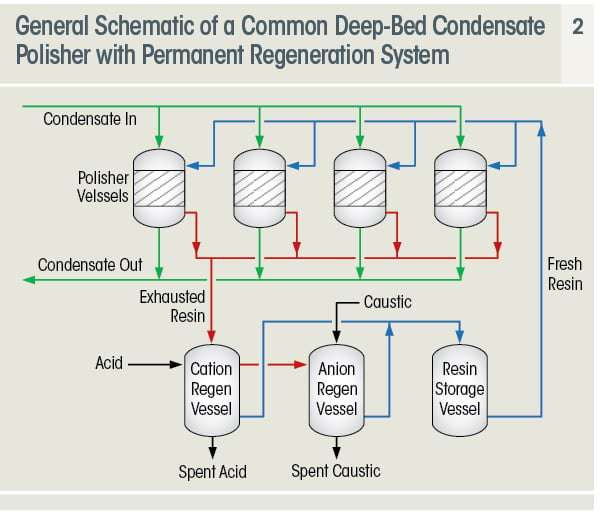
Physical depletion: attrition, fines and rising pressure drop
Repeated backwash classification, transfer and osmotic cycling chip the bead surface. Fines migrate into the lower part of the bed and plug the void space between intact beads. The first plant-visible symptom is a pressure drop that climbs steadily at a constant flow, followed by worse solids retention and, in mixed beds, a deteriorating separation interface. Whole-bead percentage and average attrition strength in the data sheet are the two figures that predict how quickly this progresses; the resins recommended for condensate duty are specified at 95% or more whole beads, with average attrition strength from 350 g per bead up to 500 g per bead depending on the grade.
Chemical and osmotic stress
Condensate treatment chemistry varies by cycle: oxygen or hydrogen operation in nuclear secondary circuits, film-passing amines and neutralising amines in fossil plants, and occasional copper and iron ingress from the condensate and feedwater system. Gel resins tolerate this well when the ionic strength is genuinely low; they suffer when the bed is repeatedly shocked between concentrated and dilute service. Macroporous structures trade some capacity for resistance to osmotic and oxidative stress, which is why they are specified where fouling or concentration swings dominate.
Fouling and the loss of separability
Organic and colloval foulants accumulate on the bead surface. In a mixed bed, fouling changes the effective density of the anion resin, so the cation and anion fractions stop separating cleanly on backwash. Once the interface is lost, the run length collapses even though the theoretical capacity of both resins is unchanged. This is the point at which regeneration stops recovering performance and replacement becomes the only economic option.
Signals that a replacement is due rather than a regeneration
• Pressure drop at design flow has risen progressively and no longer resets after a thorough backwash.
• Run length shortens cycle after cycle while regenerant consumption stays constant.
• The cation and anion fractions no longer form a clean interface after backwash classification.
• Conductivity or silica leakage rises earlier in the cycle, particularly at the start of a run.
• Fines carry over into the outlet strainers, or visible debris appears at the underdrain.
• The bed has exceeded the number of regeneration cycles for which the current grade was selected.
Resin Options for Condensate Polishing Duty
Uniform particle size strong acid cation resins
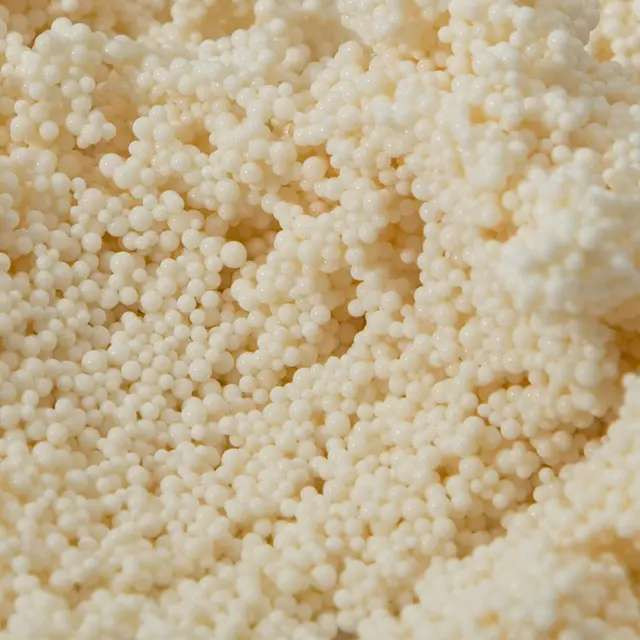
Condensate duty favours a narrow particle size distribution: it gives a steep classification boundary, low pressure drop at high flow and predictable rinse behaviour. AmberLite HPR650 H is a uniform particle size, gel, strong acid cation resin with a total exchange capacity of at least 2.0 eq/L, a moisture range of 46.0–52.0%, an average particle size of 650 ± 50 µm and a uniformity coefficient of 1.0 or less. Its particle density of 1.22 g/mL and a shipping weight of 785 g/L are the figures used to calculate the order quantity. It is rated for service from 5 °C to 150 °C, which covers condensate temperatures in both fossil and nuclear duty, and it is specified at 95% or more whole beads with an average attrition strength of 500 g per bead.
AmberLite HPR1300 H shares the same capacity, moisture, particle size and uniformity specification but is rated to 120 °C, with an average attrition strength of 350 g per bead. Where the design temperature sits below that limit, the two grades are interchangeable from a hydraulic standpoint and the choice is usually driven by the anion partner already in service.
Gel strong base anion resins for condensate duty
The anion resin in a condensate mixed bed is the more delicate half: it is less dense than the cation, more sensitive to temperature, and its ionic form determines both the finished water quality and the visible colour contrast used to confirm separation. AmberLite HPR550 OH is a uniform particle size, gel, strong base anion resin with a total exchange capacity of at least 1.1 eq/L in the hydroxide form, a moisture range of 55.0–65.0%, an average particle size of 590 ± 50 µm, a uniformity coefficient of 1.10 or less, a particle density of 1.08 g/mL and a shipping weight of 660 g/L. Its service range is 5 °C to 100 °C, whole beads are 95% or more, and average attrition strength is 350 g per bead. The ionic form is specified at 95% or more hydroxide with carbonate at 5% or less and chloride at 0.5% or less. The corresponding chloride form, AmberLite HPR550 Cl, delivers at least 1.35 eq/L, 42.0–49.0% moisture, 550 ± 50 µm average size, 1.09 g/mL particle density and 690 g/L shipping weight, and is the form in which the resin is usually shipped and initially classified.
The density difference between 1.22 g/mL cation and 1.08 g/mL anion is what makes backwash separation reliable, and the colour difference between the dark cation and the lighter anion is what lets an operator confirm the interface visually through the vessel sight glass.
Macroporous anion resins where fouling and osmotic stress dominate
Where condensate quality is variable, where organic or colloval loads are present, or where the polisher sees concentration swings, a macroporous Type I anion resin is the more durable choice. AmberLite HPR9000 OH is a macroporous, strong base anion resin with a total exchange capacity of at least 0.80 eq/L, moisture of 66.0–75.0%, an average particle size of 650 ± 50 µm, a uniformity coefficient of 1.2 or less, a particle density of 1.05 g/mL and a shipping weight of 660 g/L. It is rated 5 °C to 100 °C, specified at 95% or more whole beads, and its ionic form is stated at 95% or more hydroxide with carbonate at 5.0% or less and chloride at 0.20% or less.
AmberLite HPR900 SO4 is a macroporous strong base anion resin supplied in the sulphate form, with a total exchange capacity of at least 1.0 eq/L in the chloride form, moisture of 60.0–68.0%, a particle size range of 500–700 µm, a uniformity coefficient of 1.45 or less, a particle density of 1.09 g/mL and a shipping weight of 695 g/L. Its osmotic stability is characterised by a strong osmotic ball mill retention of 92% or more, and its swelling on conversion from the sulphate to the hydroxide form is 15% or less. The wider particle size distribution is deliberate: it suits the classification behaviour of layered and three-layer condensate polishers rather than a tightly separated mixed bed.
Inert resins for layered and three-layer polishers
Layered and three-layer condensate polishers use a floating inert layer to keep the active resins separated and to protect them from the hydraulic shock of service and backwash. AmberLite 14i is a polypropylene inert resin with a particle size of 1.2–1.5 mm, a particle density of 0.95 g/mL, a shipping weight of 500–580 g/L and a service range of 5 °C to 100 °C; it is used above the active resins in concurrent-flow and floating-bed arrangements. AmberLite 62i is a polyethylene inert resin with a coarser 2.5–4.0 mm particle size, the same 0.95 g/mL particle density, a shipping weight of 620 g/L and a service range of 5 °C to 110 °C, used as the filler layer in counter-flow regenerative clean-service beds. Because both are less dense than water, they float reliably above the active resins and are replaced on the same outage cycle as the active bed.
Pre-mixed and non-regenerable options
Where no regeneration plant exists, or where the polisher is a small polishing or start-up unit, a pre-mixed bed removes the classification problem entirely. AmberLite MB20 H/OH is a pre-mixed, regenerable bed of a strong acid cation resin and a Type I strong base anion resin, supplied with 38–44% cation and 56–62% anion by volume, at a shipping weight of 710 g/L and a service range of 5 °C to 60 °C; it produces product water with conductivity below 0.1 µS/cm under design conditions. AmberTec MR-450 UPW H/OH is a non-separable, non-regenerable mixed bed for ultrapure water polishing, with a cation capacity of at least 2.0 eq/L and an anion capacity of at least 1.1 eq/L, uniform particle size cation at 360 ± 50 µm and anion at 590 ± 50 µm, both with a uniformity coefficient of 1.1 or less and 95% or more whole beads, at a shipping weight of 704 g/L. Its specified operating window is 15 °C to 25 °C, and it is exchanged as a complete charge rather than regenerated.
Technical Data at a Glance
The values below are typical product data sheet values. They are the figures to compare when a replacement must match the duty of the bed being removed.
Table 1 — Strong acid cation resins for condensate polishing
Parameter | AmberLite HPR650 H | AmberLite HPR1300 H |
As-supplied ion form | H+ | H+ |
Total exchange capacity | ≥ 2.0 eq/L | ≥ 2.0 eq/L |
Moisture content | 46.0–52.0% | 46.0–52.0% |
Average particle size | 650 ± 50 µm | 650 ± 50 µm |
Uniformity coefficient | ≤ 1.10 | ≤ 1.10 |
Particle density | 1.22 g/mL | 1.22 g/mL |
Shipping weight | 785 g/L | 785 g/L |
Whole bead | ≥ 95% | ≥ 95% |
Average attrition strength | ≥ 500 g/bead | ≥ 350 g/bead |
Swelling (Na+ → H+) | 7% | 7% |
Service temperature | 5–150 °C | 5–120 °C |
AmberTec UP650 H is the ultrapure-water equivalent of the same 650 µm uniform particle size gel cation grade — ≥ 2.0 eq/L, 46.0–52.0% moisture, 650 ± 50 µm, uniformity coefficient ≤ 1.10, 785 g/L, ≥ 500 g per bead average attrition strength — but it is rated to 60 °C and is specified for electronics and ultrapure water polishing rather than for condensate duty.
Table 2 — Strong base anion resins for condensate polishing
Parameter | HPR550 OH | HPR550 Cl | HPR9000 OH | HPR900 SO4 |
Matrix | Gel, uniform particle | Gel, uniform particle | Macroporous, Type I | Macroporous |
As-supplied ion form | OH− | Cl− | OH− | SO4 2− |
Total exchange capacity | ≥ 1.1 eq/L | ≥ 1.35 eq/L | ≥ 0.80 eq/L | ≥ 1.0 eq/L (Cl− form) |
Moisture content | 55.0–65.0% | 42.0–49.0% | 66.0–75.0% | 60.0–68.0% |
Average particle size | 590 ± 50 µm | 550 ± 50 µm | 650 ± 50 µm | 500–700 µm |
Uniformity coefficient | ≤ 1.10 | ≤ 1.1 | ≤ 1.2 | ≤ 1.45 |
Particle density | 1.08 g/mL | 1.09 g/mL | 1.05 g/mL | 1.09 g/mL |
Shipping weight | 660 g/L | 690 g/L | 660 g/L | 695 g/L |
Whole bead | ≥ 95% | ≥ 95% | ≥ 95% | ≥ 95% |
Ionic purity | OH− ≥ 95%, CO3 2− ≤ 5%, Cl− ≤ 0.5% | not stated | OH− ≥ 95%, CO3 2− ≤ 5.0%, Cl− ≤ 0.20% | not stated |
Swelling | Cl− → OH− < 25% | ≤ 25% | Cl− → OH− ≤ 25% | SO4 2− → OH− ≤ 15% |
Service temperature | 5–100 °C | 5–100 °C | 5–100 °C | 5–100 °C |
Table 3 — Inert resins and pre-mixed beds
Parameter | AmberLite 14i | AmberLite 62i | AmberLite MB20 H/OH | AmberTec MR-450 UPW H/OH |
Type | Polypropylene inert | Polyethylene inert | Pre-mixed cation + anion | Non-separable mixed bed |
Particle size | 1.2–1.5 mm | 2.5–4.0 mm | not stated | 360 ± 50 µm (cat.) / 590 ± 50 µm (an.) |
Particle density | 0.95 g/mL | 0.95 g/mL | not stated | not stated |
Shipping weight | 500–580 g/L | 620 g/L | 710 g/L | 704 g/L |
Capacity | none (no functional groups) | none (no functional groups) | mixed-bed operating capacity | ≥ 2.0 eq/L cat., ≥ 1.1 eq/L anion |
Uniformity coefficient | not stated | not stated | not stated | ≤ 1.1 both components |
Service temperature | 5–100 °C | 5–110 °C | 5–60 °C | 15–25 °C |
Regeneration | not applicable | not applicable | regenerable | non-regenerable, exchange whole charge |
Typical duty | floating layer above active resin | filler layer in clean-service beds | service demineralisation and polishing | ultrapure water polishing |
Matching the Replacement to Your Bed Configuration
Nuclear secondary circuit and PWR mixed-bed polishers
Mixed-bed condensate polishing in PWR service places the strictest demands on ionic form and ionic purity, because the polisher is a chemistry control device as much as a clean-up device. The uniform particle size cation grades described above, paired with a gel uniform particle anion resin, give the steep classification boundary and the visible colour contrast that operators rely on after each backwash. Where the operating philosophy favours a non-separable charge that is exchanged rather than regenerated, a pre-mixed nuclear-grade or ultrapure mixed bed removes the classification risk entirely, at the cost of a defined and narrower operating window.
Fossil-fired condensate polishers and three-layer beds
Fossil duty usually means higher temperature, amine carry-over and a periodic ingress of corrosion products. Two configurations are common. In a mixed bed, select a cation and anion pair whose particle densities and colour differ enough to classify reliably at the plant's backwash rate. In a layered or three-layer bed, the anion resin sits above the cation and is held apart by an inert layer; here a macroporous anion resin with a wider particle size distribution is the more robust choice, and the inert layer must be replaced together with the active resins rather than topped up.
Industrial demineralisation and polishing duty
Where the polisher protects a demineralisation train rather than a steam cycle, the temperature requirement falls away and the selection is driven by fouling resistance and regenerant economics. Macroporous anion resins are preferred where organics or silica are present; gel resins remain the higher-capacity option on clean feeds. A pre-mixed regenerable bed is often the simplest answer for smaller polishing duties where separate regenerant handling for two resins is not justified.
Where regeneration is not available
For start-up polishers, condensate return units, turbine bypass duty and skid-mounted packages, a non-regenerable mixed bed is frequently the correct engineering answer. Confirm the operating temperature window before specifying: ultrapure-grade non-separable products are limited to a narrow band around ambient temperature and are not substitutes for a high-temperature condensate grade.
Planning the Replacement Around the Outage Window
What to survey before you request a quotation
• Vessel internal diameter, freeboard and the current working bed depth of each layer, including the inert layer.
• Underdrain type, nozzle count and the condition of the nozzle retainers.
• Strainer location and mesh size, and whether the inlet strainer was cleaned at the last outage.
• Design and maximum condensate temperature, flow rate, and the pressure drop recorded at design flow over the last twelve months.
• Oxidant and amine treatment programme, and any recent excursion in copper, iron or sodium.
• The exact product names and ion forms of the resin currently in service, taken from the delivery documents rather than from the drawing.
• The number of regeneration cycles since the last full change-out.
• The site's regenerant grades, dilution water quality and the time available for regeneration and rinse inside the outage.
How to calculate the order quantity
Start from the working volume of each layer, not from the vessel volume. Multiply the cross-sectional area of the vessel by the design depth of each layer to obtain the volume of each component, then order each resin against its own shipping weight in grams per litre to convert volume into a delivery quantity you can check on receipt. Keep the inert layer calculation separate: its volume is set by the classification behaviour of the active pair, and changing one without the other is the most common cause of a failed first cycle. State the allowance you intend to hold for loading losses as a line item in the enquiry rather than as an unexamined percentage.
Why you must specify the pair, not the product
A replacement order that names only the cation resin will be fulfilled with a cation resin. The separation interface, the pressure drop and the run length are properties of the pair. Specify the cation grade, the anion grade, their ion forms at delivery, and the inert grade and volume in the same enquiry, and ask for the pair to be confirmed against your backwash and classification conditions.
Sequencing delivery against the outage date
Work backwards from the date the vessel must be handed back. Allow separately for production, inland transport, export clearance, sea or air freight, import clearance and inland delivery to site, and hold the resin at the site in its sealed original packaging until the vessel is ready. Resin is a wet, temperature-sensitive material: it must not be allowed to dry out, must be protected from freezing, and must be kept out of direct sun. Confirm the storage guidance for the specific grade before the material arrives, and plan the loading sequence so that the first resin opened is the first resin loaded.
Receiving, storing and handling
• Check the delivery against the packing list: product name, ion form, lot number, volume and number of containers.
• Keep containers sealed and upright until the point of use; once opened, use the container completely.
• Prevent drying and freezing at every stage; a bead that has dried or frozen will not recover its physical integrity.
• Use clean, chlorine-free water for all wetting, transfer and backwash duties.
• Keep the receiving records with the commissioning dossier; they are the traceability record for the charge.
Loading, classification and layer verification
• Confirm the vessel is clean, the underdrain is intact and the strainers are in place before any resin is opened.
• Load wet, keeping the bed flooded, and avoid dropping resin from height.
• Backwash to classify and to remove the residual fines that are normal in any fresh charge.
• In a mixed bed, verify the separation interface visually through the sight glass before regeneration.
• In a layered or three-layer bed, set the inert volume by trial backwash at the design flow, then record the depths achieved.
• Record the final bed depths of every layer as the baseline for the next outage.
Regeneration, rinse and commissioning
Regenerate to the design exhauster service, at the design dilution and flow, and do not shorten the rinse to recover schedule. Rinse conductivity and, where applicable, silica and sodium leakage are the parameters that tell you whether the charge is ready; commission at a flow below design and raise the load in steps while watching the same parameters. Record the pressure drop at design flow at first commissioning — that single number is the reference against which every future replacement decision will be judged.
Application Scope and Operating Boundaries
Duty | Suitable options | Boundary to respect |
Mixed-bed condensate polishing, fossil or nuclear | Uniform particle size strong acid cation with a gel uniform particle strong base anion | Confirm the maximum condensate temperature against each grade's rated range before selecting |
Layered or three-layer condensate polisher | Macroporous strong base anion with a polypropylene or polyethylene inert layer | The inert layer and the active pair must be changed together |
High-temperature condensate duty | Grades rated to 150 °C | Gel anion grades rated to 60 °C in the hydroxide form are not suitable |
Industrial demineralisation polishing | Gel or macroporous anion with a strong acid cation | Choose macroporous where organics, silica or concentration swings are present |
Start-up and non-regenerable polishing | Pre-mixed regenerable or non-separable mixed bed | Non-separable ultrapure grades have a narrow operating temperature window |
Service water and small polishing skids | Pre-mixed regenerable mixed bed | Confirm the conductivity target and the regenerant availability on site |
Supply for a Replacement Quantity
Replacement charges are ordered by the litre against the shipping weight of each grade, and are supplied in sealed, moisture-retaining containers suited to export consignments. Because a change-out is a scheduled event rather than a stock purchase, send the vessel data, the layer volumes and the required site date in the first message; that allows the offer to be built around the outage rather than around a catalogue line. DuPont AmberLite and AmberTec products, Chinese-manufactured equivalents, EDI stack modules, reverse osmosis and ultrafiltration membranes, and complete ion exchange and deionisation packages are all supplied from the same source, which simplifies the documentation trail for a combined resin and equipment order.
Frequently Asked Questions
How do I know whether to replace the resin or regenerate it again?
Regeneration restores chemical capacity; it does not restore physical integrity. If pressure drop at design flow keeps rising, if the cation and anion fractions no longer form a clean interface after backwash, or if run length keeps shortening at constant regenerant dosage, the bed has been depleted physically and replacement is the economic choice.
Can I replace only the anion resin in a mixed bed?
You can, but the bed's behaviour is a property of the pair. Density, particle size, colour contrast and swelling together determine whether the two fractions separate on backwash. Replacing one component against an aged partner usually produces a shorter run length than either resin alone would predict, which is why a pair is specified and ordered together.
Which is better for condensate polishing, gel or macroporous anion resin?
Gel uniform particle resins give higher capacity and sharper classification, which suits clean condensate and mixed-bed duty. Macroporous resins give lower capacity but greater resistance to surface fouling and to osmotic, physical and oxidative stress, which suits variable condensate quality and layered or three-layer beds.
How is the order quantity calculated?
From the working volume of each layer: vessel cross-sectional area multiplied by the design depth of that layer. Each component is then converted to a delivery quantity using its own shipping weight in grams per litre. The inert layer is calculated separately, because its volume is set by the classification behaviour of the active pair.
What data should I send with an enquiry?
Vessel internal diameter and layer depths, underdrain type, design and maximum condensate temperature and flow, the pressure drop trend at design flow, the treatment programme, the product names and ion forms of the resin currently in service, the number of regeneration cycles since the last change-out, and the date the vessel must return to service.
How should new resin be stored before loading?
Sealed, upright and at the site's ambient conditions, protected from drying, freezing and direct sun, using clean chlorine-free water for all wetting and transfer duties. Confirm the storage guidance for the specific grade before the consignment arrives, and plan so that each opened container is used completely.
What are the acceptance checks after a change-out?
Record the final bed depth of every layer, the pressure drop at design flow, and the rinse-end conductivity together with silica and sodium leakage where those are monitored. Commission below design flow and raise the load in steps. Those first-cycle figures become the baseline for the next outage.
Are non-regenerable mixed beds suitable for condensate polishing?
They are suitable where no regeneration plant exists and where the operating temperature falls inside the product's rated window. Non-separable ultrapure mixed beds are exchanged as a complete charge and have a narrow specified temperature band, so they are not substitutes for high-temperature condensate grades.
Send Your Bed Data for a Replacement Quotation
Tell us the vessel dimensions and layer depths, the condensate temperature and flow, the pressure drop trend, the chemistry programme and the date the unit must return to service. We will confirm the cation, anion and inert grades, the quantities by layer and the applicable product data sheets, and return a technical and commercial response against your outage schedule.
Email [email protected] · Phone / WhatsApp +86-13646187144 · Wuxi Fenigal Science and Technology Co., Ltd., Building 9, Industrial Design Park, Dicui Rd. 100, Binhu, Wuxi, Jiangsu, China
Send Your Water Treatment Requirement
Tell us the feedwater, required capacity, target water quality and project conditions. Your inquiry email will automatically include the page you are viewing so our team can understand the exact product, technology or reference that led to your request.
- Feedwater source / available analysis
- Design flow or required production capacity
- Target product-water quality or process duty
- Project country, operating conditions and delivery target